Mercury Lamp or UV LED: How to Choose
Mercury lamps are 200-600 nm broad-spectrum sources compatible with almost any formulation and provide UVC; UV LEDs are single-wavelength, low-energy, tens of thousands of hours, no infrared heat or ozone.
One-sentence answer: A mercury lamp is a 200–600 nm broad-spectrum source compatible with almost any formulation, provides UVC and the highest peak irradiance, but needs warm-up, emits infrared heat and ozone, and lasts a few thousand hours. A UV LED is a 365–405 nm single-wavelength source with low energy use, tens of thousands of hours of life, instant on/off, no infrared heat and no ozone, but requires an LED formulation. The first criterion is the formulation spectrum; the second is substrate heat sensitivity and cycle time.
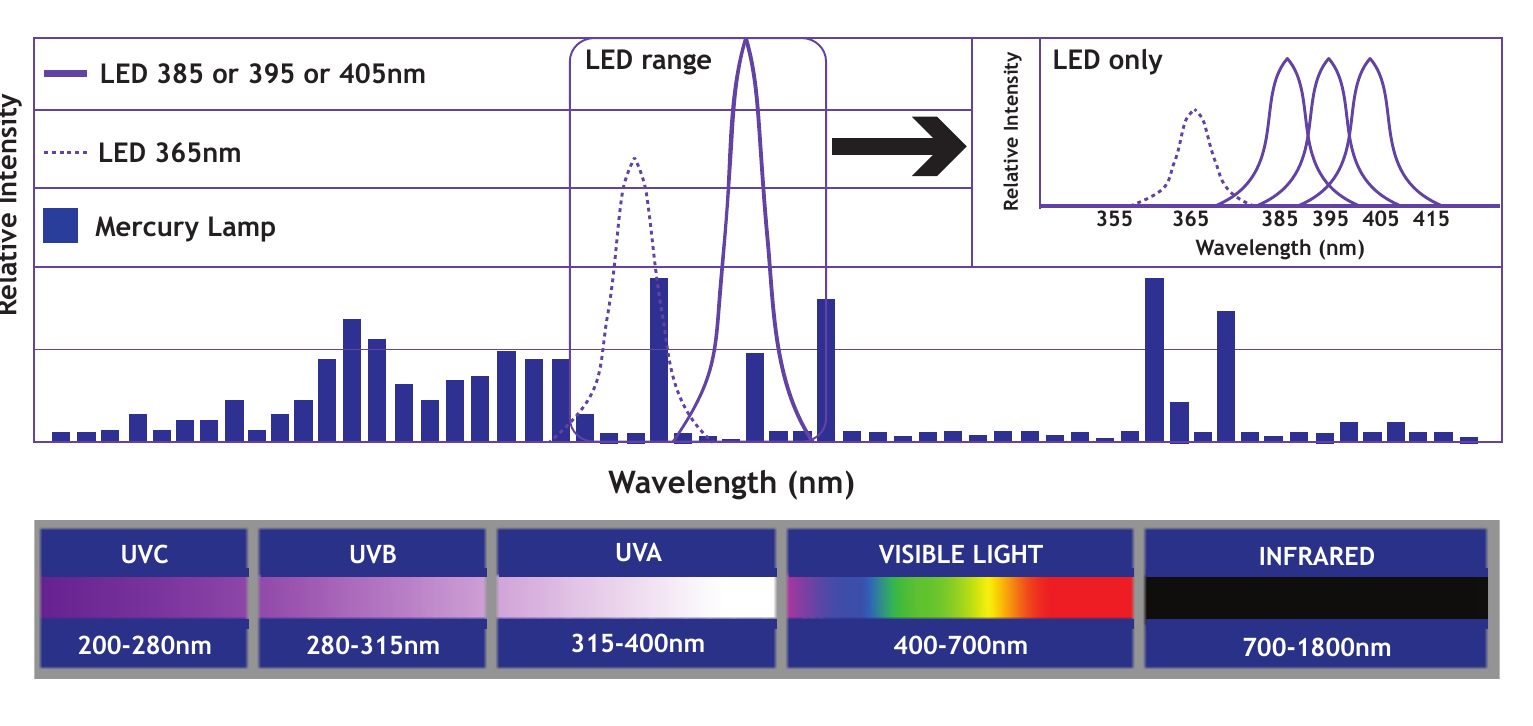
A broad-spectrum mercury lamp suits almost any formulation; an LED single peak must match the photoinitiator precisely. Image source: Excelitas UV Curing Product Selector Guide.
Comparison
| Item | Mercury lamp (short arc / medium pressure) | UV LED |
|---|---|---|
| Spectrum | 200–600 nm broad, filterable | Single peak ±10 nm |
| UVC | Yes | No |
| Peak irradiance | Up to 37 W/cm² for spot curing | 27.3 W/cm² spot, 20 W/cm² area |
| Lifetime | Short arc guaranteed 2,000 h (typical 3,500–4,000 h); medium pressure ≈1,000 h | Tens of thousands of hours; production lines exceed 50,000 h |
| Switching | ~4 min warm-up, shutter needed | Milliseconds, can be pulsed |
| Infrared heat | Significant | None |
| Ozone / mercury | Yes / contains mercury | No / no mercury |
| Power adjustment | Limited | 5–100% in 1% steps |
| Energy | Baseline | 50%+ lower |
| Consumables | Bulb, shutter, reflector | None |
| Formulation | Almost any | LED-specific |
When to choose a mercury lamp
UVC surface cure is required; a validated legacy formulation should not be re-qualified; the highest peak irradiance is needed; the formulation is undecided in development and one machine must cover the full band.
When to choose LED
The formulation is a 365–405 nm system; the substrate is heat-sensitive; short cycle times with frequent on/off; multiple independently controlled points; lower energy, exhaust and consumable costs; mercury-free requirements.
Mixed use
Many lines keep both: LED for primary cure and mercury for a UVC post-cure, or LED for new products while legacy products stay on mercury.
Related products
Mercury spot curing → OmniCure S2000 Elite (closed-loop feedback, six filters, drop-in upgrade from the original S2000). LED spot curing → OmniCure LX500. LED area curing → Phoseon air-cooled UV LED.
FAQ
Q: Does switching from mercury to LED require process re-validation?
A: The spectrum changes, the formulation usually changes, so yes.
Q: What does the 2,000-hour mercury lamp life mean?
A: Excelitas' guaranteed life for S-series short-arc bulbs; typical use is 3,500–4,000 hours.
Have a UV curing challenge?
Our engineers match the right system to your exact process — from selection to validation.