What Is Oxygen Inhibition and How Do You Fix a Tacky Surface?
Oxygen at the coating-air interface scavenges free radicals and leaves the surface tacky. Four remedies: raise irradiance, nitrogen inerting, add UVC for a fast skin, or an inhibition-resistant formulation.
One-sentence answer: Oxygen inhibition occurs when oxygen at the coating-air interface scavenges free radicals and suppresses polymerization, leaving the surface tacky or under-cured. Four remedies: raise irradiance, nitrogen inerting, add UVC to form a fast skin, or use an inhibition-resistant formulation.
Mechanism
Radicals react with oxygen to form peroxy radicals that are too unreactive to continue initiating, so the chain reaction stops at the surface. The thinner the coating, the larger the surface area and the lower the irradiance, the worse the inhibition.
Comparison of the four remedies
| Remedy | Principle | Advantage | Limitation |
|---|---|---|---|
| Raise irradiance | Radical generation outpaces oxygen consumption | Simplest | Needs a high-power source |
| Nitrogen inerting | Removes oxygen | Complete | Complex, costly equipment |
| Add UVC | Fast surface skin blocks oxygen | Also improves abrasion resistance | Needs mercury/microwave lamp; excess embrittles and yellows |
| Inhibition-resistant formulation | Amine synergists etc. | No equipment change | May affect yellowing and odor |
The medical coating example
The Excelitas application note reports that surface integrity of catheter hydrophilic coatings directly affects the coefficient of friction; a low-dose UVC exposure after UVA primary cure overcomes oxygen inhibition, promotes rapid skin formation, improves abrasion resistance and reduces particulate shedding.
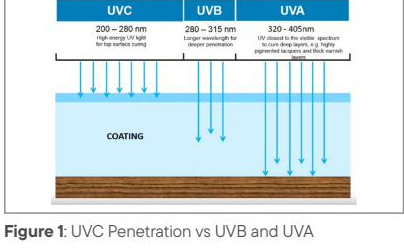
UVC handles surface cure and oxygen inhibition; UVA handles deep crosslinking. Image source: Excelitas application note "Optimizing Lubricious Coatings on Medical Devices Using UVA and UVC", Figure 1, February 2026.
Related products
High-irradiance route: OmniCure LX500 (27.3 W/cm²), Phoseon FireJet ONE (20 W/cm²). UVC route: OmniCure S2000 Elite with 250–450 nm filter or UVC liquid light guide; closed-loop feedback keeps the UVC dose consistent batch to batch.
FAQ
Q: Is a tacky surface after LED curing always oxygen inhibition?
A: Three common causes: oxygen inhibition, spectral mismatch, insufficient irradiance. Rule out the last two with a radiometer first.
Q: The bulk of a thick adhesive cures but the surface stays tacky?
A: Classic oxygen inhibition: raise irradiance or add a UVC step.
Have a UV curing challenge?
Our engineers match the right system to your exact process — from selection to validation.