Why Must the Photoinitiator and the Light Source Spectrum Match?
A photoinitiator absorbs only specific wavelengths; if the source spectrum does not overlap its absorption spectrum the reaction never starts. Mercury lamps suit almost any formulation; UV LEDs need LED-grade chemistry.
One-sentence answer: A photoinitiator absorbs only specific wavelengths; if the light source spectrum does not overlap its absorption spectrum the reaction never starts — the first rule of UV curing. Broad-spectrum mercury lamps are compatible with almost any formulation; UV LEDs have a narrow spectrum (±10 nm) and require formulations designed for that wavelength.
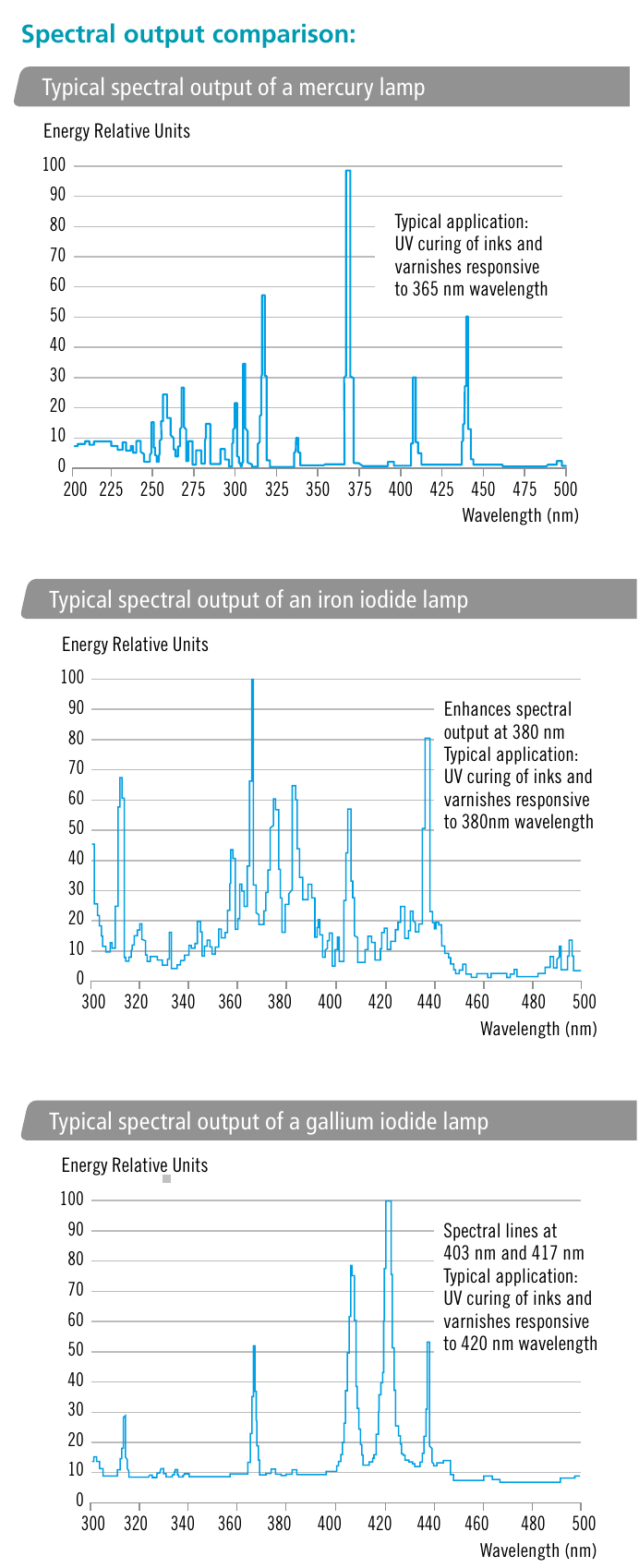
The same mercury lamp with different metal halide additives shifts its spectrum to longer wavelengths to match different photoinitiators. Image source: Noblelight Amba mercury arc lamp brochure.
Overlap of absorption and emission spectra
Plot the photoinitiator absorption curve and the lamp emission curve on the same chart: the larger the overlap, the higher the photon utilization. A mercury lamp emits at 254, 313, 365, 405, 436 nm and more, so it almost always overlaps some initiator; an LED has a single peak that must hit exactly.
Three common situations
| Situation | Symptom | Remedy |
|---|---|---|
| Mercury formulation switched directly to LED | Tacky surface or no cure | Change to LED-grade formulation, or keep the mercury lamp |
| Pigmented / white systems | Pigment absorbs UV, depth does not cure | Use long wavelengths (385–405 nm) or metal halide lamps |
| Legacy photoinitiators | Single-wavelength LED insufficient | Add UVC, or dual light sources |
LED formulations are now mainstream
The Selector Guide notes that the near-monochromatic LED output "requires new chemical formulations"; today ink, coating and adhesive suppliers routinely offer LED versions. Before switching light sources, confirm the recommended wavelength and minimum irradiance with the formulation supplier.
Related products
LED formulation in hand → OmniCure LX500 (spot), Phoseon air-cooled UV LED (area). Formulation undecided or broad-spectrum compatibility needed → OmniCure S2000 Elite, which covers 250–500 nm with interchangeable filters and can simulate different light sources during development.
FAQ
Q: If the adhesive datasheet says "UV curable", will it work with LED?
A: Not necessarily; confirm the initiator absorption peak lies within 365–405 nm.
Q: What is the difference between 365 nm and 395 nm initiators?
A: 365 nm initiators are more numerous and cure more completely but penetrate less; 395/405 nm penetrate deeper and LEDs are more efficient there, suiting thick and pigmented systems.
Have a UV curing challenge?
Our engineers match the right system to your exact process — from selection to validation.