Irradiance vs Dose: Why Enough Dose Can Still Give a Poor Cure
Peak irradiance (W/cm²) determines cure speed and depth; dose (J/cm²) determines whether enough energy was delivered. The same dose at different irradiance gives a different crosslink network.
One-sentence answer: Peak irradiance (W/cm²) is the instantaneous optical power per unit area at the surface and determines cure speed and depth; energy density or dose (J/cm²) is irradiance integrated over time and determines whether enough energy has been delivered for full cure. The same dose at different irradiance levels gives a different crosslink network and surface properties, so a process window must specify both.
The three process parameters
| Parameter | Definition | Unit | Determined by |
|---|---|---|---|
| Spectral output | Radiant power distribution across wavelengths | nm | Source type, bulb fill, filter |
| Peak irradiance | Radiant power per unit area at the surface | W/cm² | Source power, working distance, optics |
| Energy density (dose) | Energy accumulated during exposure | J/cm² | Irradiance × time |
Why higher irradiance is better
Free-radical generation rate is proportional to irradiance. At high irradiance the radical concentration overcomes oxygen inhibition and penetrates pigmented layers, so surface and depth cure together; low irradiance for a long time can cure the surface first and seal the bottom, or let oxygen inhibition leave the surface tacky.
The effect of distance
Irradiance falls off rapidly with working distance. Reflectors, focusing lenses and LED primary/secondary micro-optics can hold irradiance at greater distances; every published peak value corresponds to specific conditions (e.g. "3 mm lens, 10 mm distance" or "WD = 1 mm") and must be re-measured when conditions change.
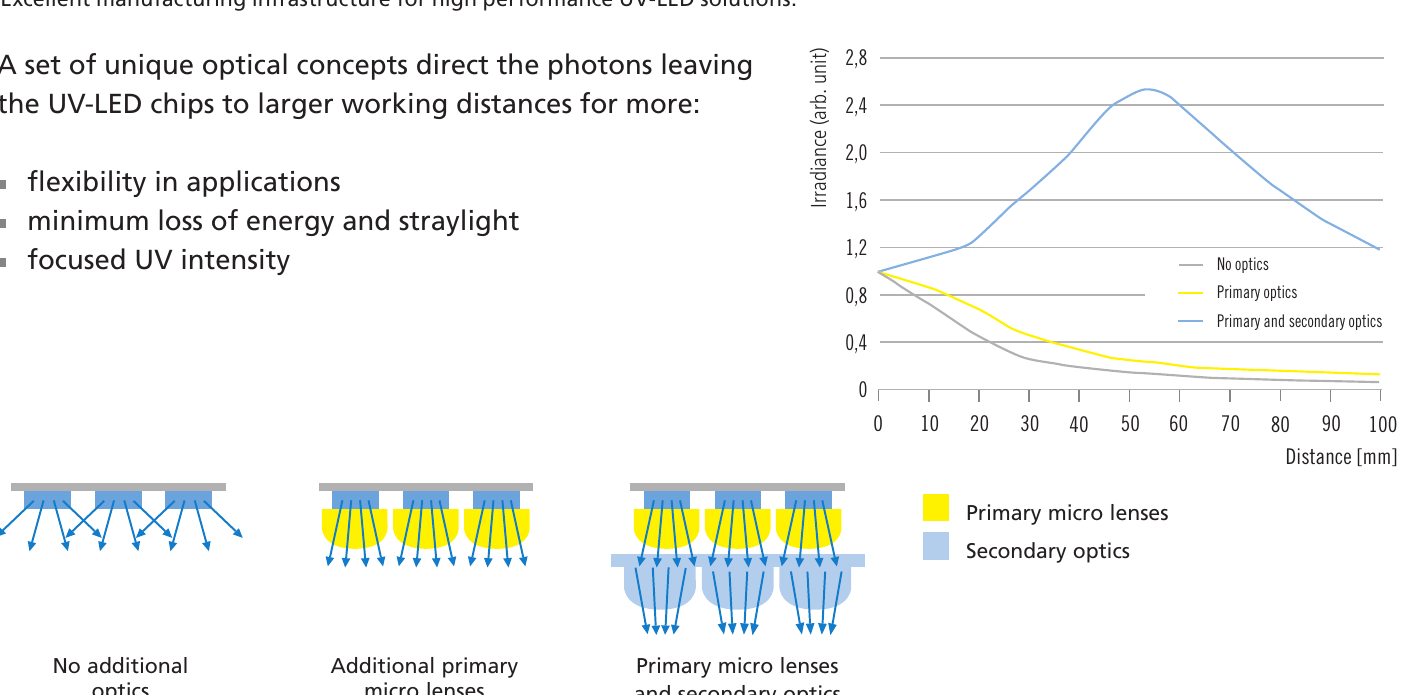
Irradiance decays with distance; dedicated optics can move the peak to a 50–60 mm working distance. Image source: Noblelight UV LED products overview.
Steps to build a process window
- Obtain recommended wavelength, minimum irradiance and minimum dose from the formulation supplier.
- Measure irradiance with a radiometer at the actual cure position.
- Calculate dose from line speed or exposure time; test adhesion, hardness and surface cure.
- Keep 20–30% margin above and below the passing range as alarm thresholds.
Related products
Highest peak irradiance: OmniCure S2000 Elite 37 W/cm², OmniCure LX500 27.3 W/cm² at 385 nm, Phoseon FireJet ONE 20 W/cm². Long-term dose stability: S2000 Elite closed-loop feedback ±5%, LX500 Intelli-Lamp LED ±5%.
FAQ
Q: How do mW/cm² and mJ/cm² convert?
A: mJ/cm² = mW/cm² × seconds. Example: 500 mW/cm² for 4 s = 2,000 mJ/cm² = 2 J/cm².
Q: Why does an LED line with adequate dose cure worse than a mercury line?
A: Usually spectral mismatch or oxygen inhibition, not dose.
Have a UV curing challenge?
Our engineers match the right system to your exact process — from selection to validation.