What Is a UV Radiometer and Why Must a Curing Process Be Calibrated?
A UV radiometer is the only way to turn nominal equipment values into actual process values. Mercury and LED sources need differently calibrated instruments, measured at the real cure position.
One-sentence answer: A UV radiometer measures irradiance (W/cm²) or optical power (W) at the cure position and is the only way to turn "nominal equipment values" into "actual process values". Mercury and LED sources need differently calibrated radiometers; measurement must be made at the actual cure position, at the correct focal height, with the beam aligned to the detector, and traced to a national standard such as NIST.
Why nominal values cannot be trusted
- Irradiance decays with distance; nominal values apply to a specific lens and distance.
- Every optical accessory (light guide, cure ring, elbow) has loss; cure-ring output is lower than light-guide tip output.
- Sources decay over time.
Measuring mercury vs LED
| Item | Mercury | LED |
|---|---|---|
| Spectrum | Broad, needs a broadband detector | Monochromatic, calibrated per wavelength |
| Beam | Larger light-guide face | Narrow beam, must be centered on the detector at the right focal height |
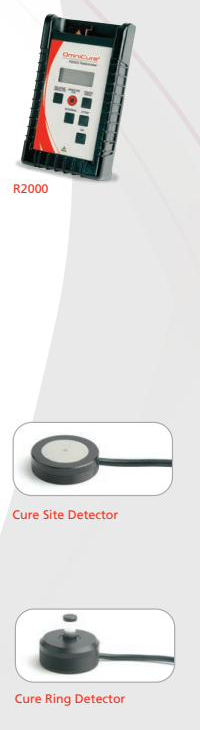
| Special measurement | Cure-ring and cure-site detectors measure directly at the bond | Beam positioning kit guarantees repeatable alignment |
| Excelitas instrument | OmniCure R2000 (NIST traceable) | OmniCure LS200 / LS200P (±10%, NIST/NRC traceable, 1-year calibration interval) |
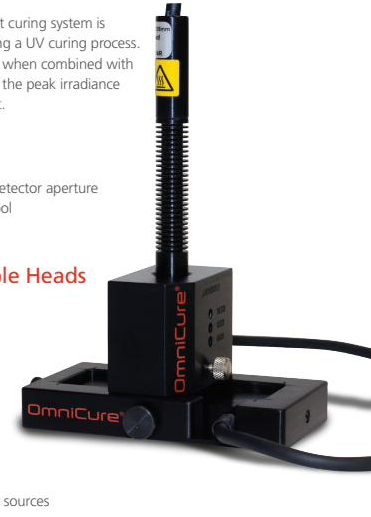
A narrow LED beam must be centered on the detector at the correct focal height; the beam positioning kit makes the measurement repeatable. Image source: OmniCure LX500 brochure.
Every connection in the light path loses energy; measure at the actual cure position. Image source: OmniCure product catalog.
Recommended calibration routine
- Measure a baseline after installation and record lens, distance and intensity setting.
- Check every shift or batch; deviation beyond ±10% triggers adjustment.
- Re-measure after changing light guides or lenses.
- Cross-compare multiple units with the same radiometer.
- Send the radiometer for calibration on schedule (LS200: 1 year).
Related products
OmniCure S2000 Elite with the R2000 displays irradiance in real time and is the only mercury spot system that can be calibrated in real time to NIST. OmniCure LX500 has a built-in radiometer and calibrates in-line with the LS200 and beam positioning kit. Phoseon air-cooled fiber systems provide a mounting position in the FRU for irradiance monitoring.
FAQ
Q: Can I use a mercury radiometer on an LED?
A: No; the spectral response differs and the reading is meaningless. LEDs need detectors calibrated at 365/385/395/405 nm.
Q: Do I need to measure both irradiance and dose?
A: The radiometer measures irradiance; dose is calculated from irradiance × exposure time (or line speed). Both belong in the process document.
Have a UV curing challenge?
Our engineers match the right system to your exact process — from selection to validation.