What Do UVA, UVB and UVC Each Do in Curing?
UVC is absorbed at the surface and overcomes oxygen inhibition; UVA penetrates deepest for uniform crosslinking through the coating; 405 nm near-visible light suits thick and pigmented systems.
One-sentence answer: UVC (200–280 nm) is strongly absorbed at the surface and drives fast skin formation and overcomes oxygen inhibition; UVB (280–315 nm) acts near the surface; UVA (315–400 nm) penetrates deepest and provides uniform crosslinking through the coating; 405 nm near-visible light penetrates further still and is used for thick or pigmented systems.
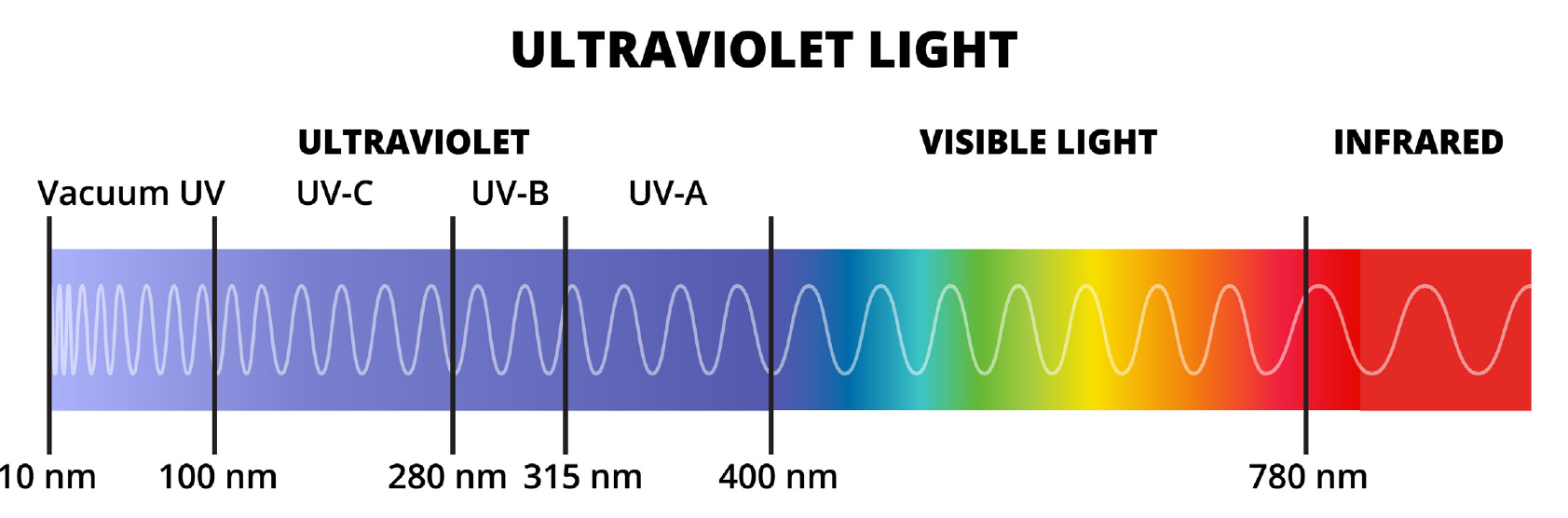
UV curing mainly uses the UVC, UVB and UVA bands; the shorter the wavelength, the shallower the penetration. Image source: Excelitas UV Curing Product Selector Guide.
Wavelength and penetration depth
The shorter the wavelength, the more strongly it is absorbed and the shallower it penetrates. UVC energy is spent almost entirely in the top few microns; UVA reaches the bottom of the coating and even passes through transparent substrates.
| Band | Wavelength | Penetration | Role | Provided by |
|---|---|---|---|---|
| UVC | 200–280 nm | Very shallow | Surface cure, anti-oxygen inhibition, activates legacy photoinitiators | Mercury lamps, microwave lamps |
| UVB | 280–315 nm | Shallow | Near-surface cure | Mercury lamps, microwave lamps |
| UVA | 315–400 nm | Deep | Uniform deep crosslinking | Mercury, microwave, LED 365/385/395 nm |
| Near-visible | 400 nm+ | Deepest | Thick layers, pigmented systems, through glass/plastic | Metal halide lamps, LED 405 nm |
Why "UVA plus a little UVC" works better
An Excelitas application note (February 2026) on hydrophilic medical coatings shows that adding a brief, low-dose UVC exposure after the UVA primary cure removes surface tack, improves abrasion resistance, reduces particulate shedding, shortens total exposure time and can activate legacy photoinitiators that single-wavelength LEDs struggle with. Excessive UVC, however, causes brittleness, yellowing or substrate damage, so the UVA/UVC ratio must be matched to photoinitiator, coating thickness and line speed.
Ozone and safety
UVC below 240 nm generates ozone from air, so mercury and microwave lamps need exhaust; UV LEDs (365–405 nm) generate no ozone and contain no UVB/UVC, so protection requirements are lower.
Related products
Need UVC or full-band switching → OmniCure S2000 Elite (six filters including 250–450 nm, UVC liquid light guides). UVA/near-visible only → OmniCure LX500 (365/385/395/405 nm LED heads), Phoseon air-cooled UV LED (365/385/395/405 nm).
FAQ
Q: Which band cures through glass?
A: Glass blocks almost all UVC/UVB; use 395 or 405 nm.
Q: Can LEDs provide UVC?
A: Standard curing LEDs do not cover 200–280 nm; a UVC step needs a mercury or microwave lamp.
Have a UV curing challenge?
Our engineers match the right system to your exact process — from selection to validation.